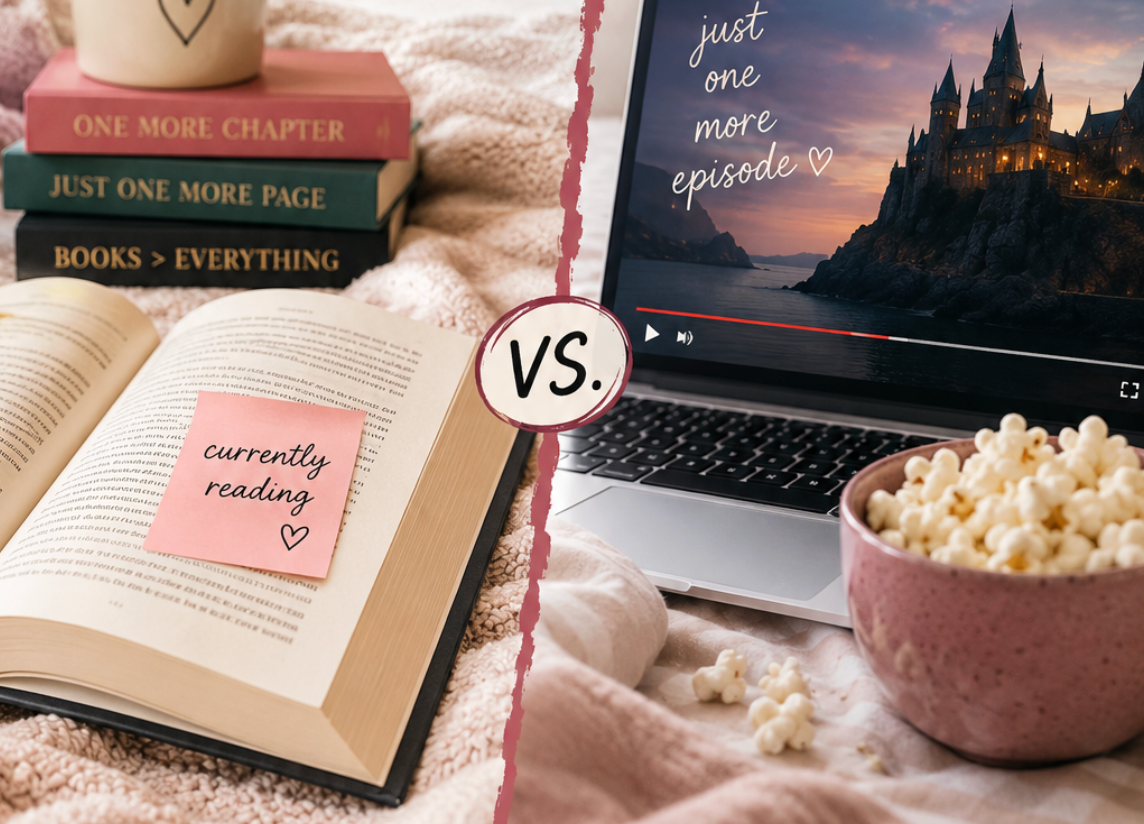
There are two types of BookTok girlies in this world.
The girl who hears a popular book is becoming a movie and immediately thinks: I NEED TO READ IT BEFORE IT COMES OUT.
And the girl who watches the movie, becomes completely obsessed, discovers there’s a book, and has it in their Amazon cart and on their Goodreads TBR before the credits finish rolling.
I tend to fall into the first category.
But the thing is: there’s really no right or wrong way to experience a book-to-screen adaptation.
Reading first and watching first both have their advantages. And whichever one you choose can completely change the way you experience the story the second time around. Because the first version you experience tends to become your reference point.
Read the book first? You build the characters, settings, voices, and entire world in your own head—and then get to see how Hollywood’s version compares.
Watch first? The actors, sets, costumes, soundtrack, and cinematography build that world for you—and the book becomes an opportunity to go deeper.
So…
Are you a book-first or screen-first girly?
Let’s find out 🧐📚🎬
You’re Probably a Book-First Girly If…
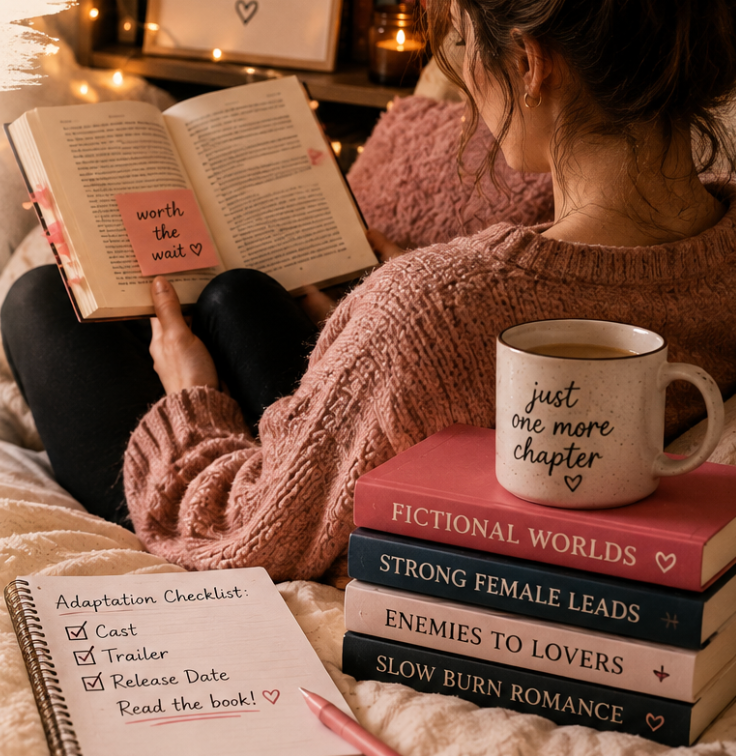
You need to build the world in your own head first.
No casting director is going to tell you what your fictional boyfriend looks like. Thank you very much 👏
One of the best parts of reading is that before an adaptation exists in your mind, everything belongs to your imagination.
You decide what the characters look like. You hear their voices. You picture the houses, the clothes, the tiny coffee shop where they inevitably fall in love…
And then the casting announcement drops.
Sometimes you think: OH. They nailed it.
Other times? You stare at your phone for approximately five minutes trying to understand how Hollywood could betray you like this?
You live for the little details.
Inner monologues. Foreshadowing. Backstories. Side characters. Tiny interactions that become incredibly important 200 pages later.
You want ALL OF IT.
Movies and television shows have limited time. Books don’t have that same restriction, which means reading first often gives you a much deeper understanding of the characters, their relationships, and why they behave the way they do.
And once you know those details?
Oh, you’re watching for them.
You don’t mind putting in the hours.
Read 400 pages before watching a two-hour movie? Sign us up.
In fact, an adaptation announcement might be exactly what finally moves that book from your TBR to “Currently Reading” on Goodreads.
Priorities.
You have VERY strong casting opinions.
Because you’ve already cast and directed the entire adaptation in your head.
You’ve spent 400 pages with these people.
You know them.
So when the official cast gets announced, you either immediately see the vision…
Or suddenly become very passionate about a casting decision you had absolutely nothing to do with.
You notice. Every. Change.
“That wasn’t in the book.”
“He didn’t say that.”
“They skipped the entire scene!”
“WHAT ABOUT ___’S ENTIRE BACKSTORY?!”
“Did they even READ the book before filming this?!”
Some changes make sense. Some might even make the story better on screen. And others will have you staring at the TV wondering who approved this decision.
Your philosophy:
✨ I need the REAL story first.
You’re Probably a Screen-First Girly If…
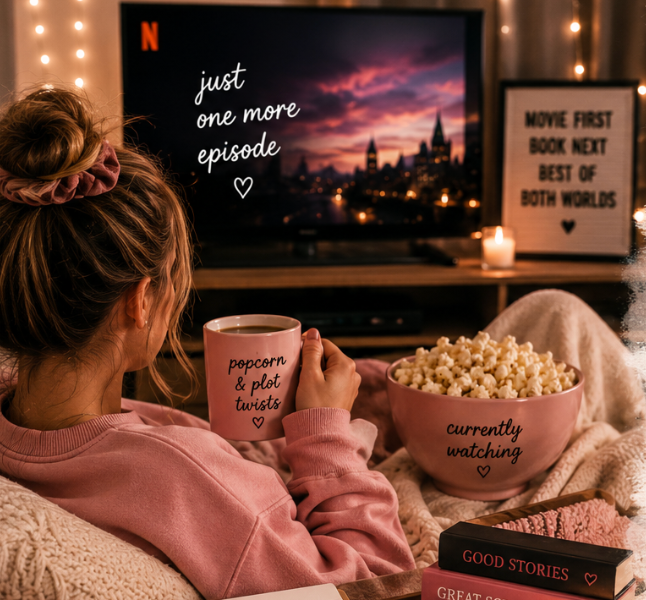
You love having the world built for you first.
Give us the hot actors.
Give us the cute little town or sprawling city setting.
Give us the sweeping landscape shot with a perfectly timed soundtrack.
We’ll take it from there.
Movies and television can do things books simply can’t. Music, cinematography, performances, costumes, and production design can all create an immediate emotional atmosphere.
There’s something pretty magical about experiencing a story that way for the first time.
You actually find the book easier to visualize afterward.
Why spend three paragraphs trying to determine what the fictional English manor looks like when Netflix has already spent several million dollars showing you?
Let the production designer do the mental imagery for you.
When you eventually pick up the book, you already have faces, voices, locations, and an entire visual world stored in your head.
For readers who sometimes struggle with visualization—especially in complicated fantasy or sci-fi worlds—that can be a HUGE advantage.
You like to test-drive a story before committing 10+ hours.
Two-hour movie first.
400-page book second.
You efficient queen.
Sometimes you simply don’t know whether you’re interested enough in a story to spend days reading it.
A movie or a few episodes of a show can give you the premise, characters, and overall vibe before you commit to the source material.
You don’t know what’s missing—and honestly, that’s kind of peaceful.
This might be the greatest screen-first advantage of them all.
A beloved side character was cut? You don’t know her.
An iconic chapter disappeared? Never met him.
They changed the ending?
What ending?
No deleted scene can hurt you if you never knew it existed.
Meanwhile, the book-first girl sitting next to you is having an existential crisis because one sentence was missing.
You read the book afterward because you need MORE.
This is where screen-first gets really fun.
You loved the movie. You aren’t ready to leave the characters.
So you pick up the book and discover…
There’s so much MORE.
More romance?!
More backstory?!
MORE SCENES?!
Instead of experiencing the adaptation as a shortened version of something you already love, you get to experience the book almost like an extended edition.
Everything new feels like bonus content.
You can enjoy the adaptation for what it is.
There is no mental checklist running in the background.
No comparison to Chapter 17.
No waiting anxiously to see whether they included your favorite line.
You can simply watch the movie as a movie.
What a peaceful existence.
Your philosophy:
✨ Hook me first. Give me the extended edition later.
So, Does It Actually Matter Which One You Experience First?
Technically?
No.
But I do think it changes your experience.
Whichever version comes first tends to anchor the story in your mind.
If you read first, your imagination creates the reference point. The author’s descriptions become your world, and when you eventually watch the adaptation, you’re comparing Hollywood’s interpretation to the version you’ve already created.
If you watch first, the screen version creates the reference point. The actors become the characters. Their voices become the voices. The sets become the locations.
Neither is inherently better.
They’re just very different ways of meeting the same story.
And both come with some pretty major advantages—and disadvantages.
📚 The Case for Reading the Book First
The biggest advantage?
The story is completely yours before Hollywood gets involved.
You get the full context—inner monologues, backstories, subplots, foreshadowing, and all those tiny character moments that don’t always survive the jump to screen.
And perhaps most importantly:
You get the twists before the internet—or the movie—spoils them.
But there is a price: expectations.
Once you’ve read the book, you know which scenes matter, how you pictured the characters, and exactly why that seemingly insignificant line in Chapter 4 becomes devastating later.
So when the adaptation changes something?
You notice instantly.
That’s the book-first trade-off: you get the complete story first, but you also walk into the adaptation with expectations—and sometimes even a perfectly good movie can’t compete with the version you’ve already fallen in love with.
🍿 The Case for Watching First
The biggest advantage of watching first is almost the exact opposite:
You get to judge the adaptation on its own terms.
Instead of cataloguing everything that’s different, you can simply enjoy the performances, cinematography, music, costumes, and story for what they are.
And if you love it?
You have an entire book waiting for you.
Suddenly, all the additional scenes, inner thoughts, backstories, and subplots feel like bonus content. It’s basically the deluxe edition of a story you already love.
But there’s one major downside:
You can’t unsee the adaptation.
Once an actor becomes a character in your mind, good luck evicting them.
That’s their face. That’s their voice. That’s their house.
And you already know where the major plot is headed.
So you’re sacrificing some imagination and suspense—but in exchange, you get to experience the adaptation without constantly wondering what Hollywood changed.
So…Which Should You Do First?
This is probably very anticlimactic after everything I just wrote, but:
Whatever you want. 😂
There’s no universally correct way to experience an adaptation.
And, I can’t believe I’m saying this, but sometimes a book really is worth reading first…
and sometimes all you need is the movie.
If you love building fictional worlds in your imagination, obsessing over tiny details, and experiencing the author’s complete version of the story before anyone else interprets it for you?
You’re probably a book-first girly.
If you love cinematic storytelling, appreciate having visual anchors, and would rather fall in love with a story before committing hours to reading it?
Screen-first might actually give you the better experience.
Personally, I can enjoy stories either way.
But if you make me choose?
I’m reading the book first. And here’s why:
I’d rather read an amazing book and risk being disappointed by its adaptation than watch an amazing adaptation and realize afterward that I just spoiled an even better book.
Once I know the twist, I can’t unknow the twist.
For Page vs Screen Reviews, that means I’ll almost always be meeting these stories on the page first—and then heading to the screen to see what Hollywood kept, changed, cut, and occasionally made even better.
And the good news?
I’ve got you covered either way! 😉
Whether you’re trying to squeeze in the book before opening night or wondering whether the book is worth picking up after the credits roll, you can follow along with my Adaptation Index for upcoming book-to-screen adaptations and all the reviews, news, and comparisons that come with them.
So now I want to know: Are YOU a book-first or screen-first girly? 📚🍿
Let me know in the comments below. Thanks for reading 💕